
There is no definitive Uzbek plov. Every cook has a different recipe, every family swears theirs is the best, and every city has its own traditions. And, basically, every one is delicious. This is my plov — a recipe inspired by Uzbekistan, but meant to be cooked, shared, and enjoyed wherever you are. – Silk Roads: A Flavor Odyssey with Recipes from Baku to Beijing by Anna Ansari, DK Books.
Follow Anna on IG
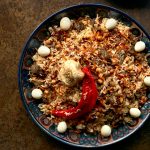
AN UZBEK PLOV
Servings 4 to 8 servings
Ingredients
- 500 g (1lb 2oz) basmati rice
- 3 tbsp fine sea salt
- 400-500 g (14oz–1lb 2oz) diced lamb shoulder or beef chuck
- 1 tsp freshly ground black pepper
- 150 ml (5fl oz/scant 2 ∕3 cup) ghee or neutral oil
- 2 onions thinly sliced into half-moons
- 3-4 carrots about 400g/14oz, peeled and cut into 3–6cm (1 1/4 – 2 1/2 in) matchsticks
- 400 g (14oz) can chickpeas, drained and rinsed
- 100 g (3 1/2 oz) barberries, raisins, or chopped dried apricots
- 2 tbsp cumin seeds toasted
- 1 garlic bulb top 1cm (1/2in) cut off so you can just make out the raw cloves
- 1 long thin red or green chilli
- Hard-boiled quail eggs to serve
Instructions
- Rinse the rice 3–4 times in cold water, then tip into a large bowl of cold water, add 1 tablespoon of the salt and leave to soak for at least 1 hour.
- Season your meat with 1 teaspoon each of the fine sea salt and black pepper.
- In a medium saucepan for which you have a lid, heat the ghee or oil over a medium–high heat. Once it is hot and glistening, reduce the heat to medium and add the onions, along with 1⁄2 teaspoon of the salt. Cook, stirring occasionally, for 8–10 minutes, or until golden.
- Add the meat and cook for 2–3 minutes, stirring occasionally, until it is no longer pink on the outside. Add the carrots and 1 teaspoon water, then cook for another 5 minutes, stirring frequently.
- Drain your soaking rice in a fine colander over the sink. Rinse the rice with cold water to remove most of the salt in which it’s been soaking.
- Return your attention to the pan. Pick up a carrot. Is it limp? Yes? If so, you’re ready for the next step. Reduce the heat to medium–low, then layer in the chickpeas and dried fruit. Don’t mix them together, just use the back of a wooden spoon to smooth everything out across the pan. Sprinkle over 1 tablespoon of your toasted cumin seeds and 1⁄2 tablespoon of the salt, distributing them as evenly as you can across the top.
- Now, add the rice to the pan, again using a wooden spoon to spread it across the top in an even layer, gently pressing down as needed. Sprinkle over the remaining cumin seeds, along with another 1 tablespoon salt, again distributing them as evenly as you can.
- Carefully pour in 700ml (2 3⁄4 cups/generous 1 pint) water, drizzling it around, or pouring it in at an angle at the edge of the pot so as to not to disturb the rice. Plop your garlic bulb into the middle of the pan, cut-side down. Gently push the garlic down into the rice until it’s just below the surface of the water. Plop your raw chilli next to the garlic and push it under in the same way.
- Increase the heat to medium, then cover the pan with a lid and cook for 25 minutes.
- Now wrap the lid of the pan in a clean tea towel and put the towelled lid back on the pan. Turn the heat off and let your rice sit, towelled and undisturbed, for 25 minutes.
- Dish the plov out on to a platter. Mix together all the constituent parts and enjoy your trip to Uzbek rice heaven.
Notes
Ideally, you would use a medium-grain Uzbek rice, but that is pretty impossible to come by outside of Central Asia, so I have written this with basmati, as it’s easily accessible. If you are able to find Turkish/baldo rice, give it a go with that.
Same thing goes for the oil: unless you have a secret supplier of unrefined Uzbek cottonseed and/or melon seed oil, use ghee or whatever neutral oil you have.
To make this vegetarian, leave out the meat and add an additional can of chickpeas.
Same thing goes for the oil: unless you have a secret supplier of unrefined Uzbek cottonseed and/or melon seed oil, use ghee or whatever neutral oil you have.
To make this vegetarian, leave out the meat and add an additional can of chickpeas.










Posted in Main Dishes