
Aka the Speediest Method for Small Pieces
The definitive cookbook for candying fruit, and baking with it, filled with delicious, beautiful, and surprisingly uncomplicated recipes from Master Preserver Camilla Wynne. — Natures’s Candy. Camilla Wynne, Appetite by Random House
Follow Camilla on IG.
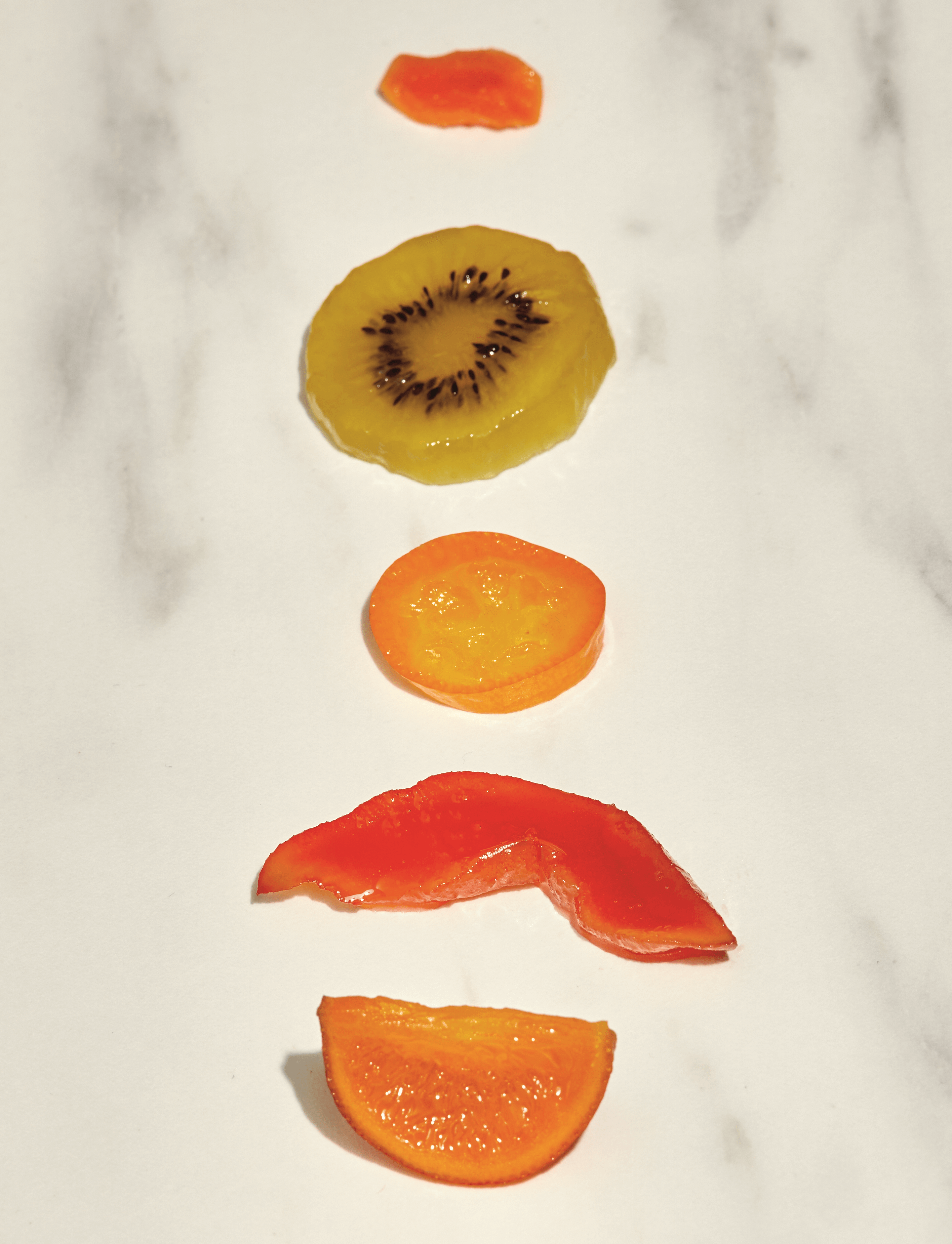
If you’re new to candying, start here. I learned this quick method from the excellent book Tartine by Elisabeth Prueitt and Chad Robertson. It has its limits, in that it will only work for relatively small pieces of fruit (if you want to candy a whole fruit or large pieces using a method closer to that of an artisan confectioner). It also won’t make a product that is completely shelf-stable, but you can’t beat it for speed! The final product works beautifully for baking with or serving on its own.
Only use fruit with a strong cell structure that can handle a hearty simmer (not raspberries, for instance). Good candidates include pineapples, kiwis, quinces, pears, cherries, apple peels, and thin-skinned citrus like clementines and kumquats.
Because only you know how much fruit you want to candy, I prefer to use ratios. The ratio for the syrup is 1:1 water to sugar by cup, so make as much or as little as you need, depending on how much fruit you have. While I generally prefer to measure by weight, what’s important here is that there is enough syrup to cover the fruit. For each cup of prepared fruit, you’ll need about 190 mL (¾ cup) water, 150 g (¾ cup) sugar, and 1 tablespoon glucose or light corn syrup.
To prepare the fruit, peel, core if necessary, and slice about ¼ inch thick. Cherries should be halved and pitted. Clementines can be cut into six to eight wedges. Kumquats can be sliced or quartered.
To candy the fruit, in a medium saucepan, bring the water, sugar, and glucose to a boil over high heat, stirring occasionally to dissolve the sugar. Add the fruit and immediately reduce the heat to a gentle simmer. Cook until the fruit is uniformly glossy and translucent, anywhere from 15 to 45 minutes depending on the fruit. Soft fruits like cherries, for instance, will take less time, while dense fruits like quinces will take the longest. Remove from the heat and allow to cool completely in the syrup at room temperature, preferably overnight, before storing, drying, or finishing.
So now that you’ve candied all this fruit, what next? You’ve got options. You can store it in syrup, dry it, and then finish it—in that order.
Store It
If I’m not sure how I’m going to use my candied fruit, I store it in its syrup in the refrigerator. This gives me the versatility to just drain it (saving the syrup!) and use in recipes as needed, or to dry it for serving in the future. To store, place the fruit in a clean jar or other airtight container and cover completely with syrup, even if this means filling the jar all the way to the brim with little to no headspace. The more air there is in the jar, the more likely that something like mold will develop. Label and date the jar and store it in the refrigerator, and use a clean utensil when removing any pieces. Properly candied fruit should keep for
at least 4 months this way, and likely longer.
Dry It
Drying is the method I use for serving candied fruit as is, using as décor, using in recipes that can’t handle extra humidity, or storing when I have no room left in the refrigerator.
To dry, drain the candied fruit from its syrup (though don’t throw that syrup away!), then use one of the following methods.
At room temperature: This is the easiest, most hands-off method, the one I usually use despite owning a food dehydrator. That said, it’s only a good choice if you live somewhere that isn’t super humid. Place fruit on a wire rack set over a rimmed baking sheet. Depending on the temperature and humidity of your home and the moisture content of the fruit, it can take 1 to 3 days to dry this way.
In the oven: This is a good option if you’re in a hurry to dry your fruit but don’t own a food dehydrator. Preheat the oven to its lowest temperature (likely 150°F to 170°F/65°C
to 75°C). Place fruit on a wire rack set over a rimmed baking sheet. Check the fruit every hour or so—it can take anywhere from 2 to 7 hours depending on the fruit, but
you don’t want to overdry it.
Using a food dehydrator: This is the best method for drying quickly—it could take anywhere from a couple of hours for fruit chips to overnight for larger pieces. Its low temperature (135°F/57°C) is best for candied fruit and is gentler than the oven, but more powerful than room temperature.
No matter which method you choose, fruit should be dry but still pliable, and if you intend to finish your fruit with a
sugar coating, make sure the fruit is still tacky (otherwise the sugar won’t stick!). Once dry, if not serving immediately, store candied fruit in an airtight container. Candied fruit is stable at 75 Brix, but you probably don’t have a refractometer (the tool that measures Brix) at home, nor are these methods likely to result in candied fruit that is saturated. Still, properly candied and dried fruit should keep at cool room temperature for at least a few months. If you’re storing a very humid fruit for a long period, consider keeping it in the refrigerator, just as extra insurance.
Finish it
You can serve candied fruit as is or finish it with a coating of glaze, sugar, or chocolate.
With glaze: A dip in concentrated sugar syrup will create a shiny protective coating. Prepare a syrup by boiling 200 g (1 cup) sugar and 85 mL (⅓ cup) water until the sugar has dissolved. Set a wire rack over a rimmed baking sheet. Use a fork to dip dried candied fruit into the hot syrup, then place on a wire rack to dry overnight.
With sugar: For a sparkly finish, dry the fruit until tacky, then roll it in sugar. You can use granulated, superfine, or flavored sugar. If the candied fruit is too dry
for sugar to stick, dip the fruit briefly in hot water before coating, then let dry completely.
With chocolate: Dip dried candied fruit in tempered chocolate and let set before storing somewhere cool and dry.
Finished candy can keep in an airtight con- tainer at room temperature for at least a couple of months if properly candied and dried. Beyond using it in your favorite recipes
or the recipes in the next section of this book (destined to become your favorites!), you can use candied fruit to decorate cakes and other bakes, garnish cocktails, serve with cheese (trust me), eat on their own, or gift in a candy or chocolate box.
Credit Line
Excerpted from Nature’s Candy by Camilla Wynne. Copyright © 2024 Camilla Wynne. Photographs by Mickaël A. Bandassak. Published by Appetite by Random House®, a division of Penguin Random House Canada Limited. Reproduced by arrangement with the Publisher. All rights reserved.